Wednesday, January 27, 2016

Thursday, January 21, 2016
Wordless Wednesday #5
 |
| Coach Yard 1948. Nice mixture of heavyweight and streamlined passenger cars and a steam switcher. The terminal dome is in background right, and the field lights at Cincinnati Reds stadium (Crosley Field in 1948) back left. The first of 6 Lima-Hamilton 750hp diesel switchers will be purchased the following year by Cincinnati Union Terminal Co. Original photo by Allan Kain, Cincinnati Enquirer. |
Wednesday, January 13, 2016
Wordless Wednesday #4
 |
| A collection of locomotives at the Cincinnati Union Terminal locomotive servicing yard, circa 1956. |
Thursday, December 31, 2015
First draft of CUT track plan
I probably shouldn't have posted this right on top of a Wordless Wednesday post, but oh well it's my blog and I can do what I want with it.
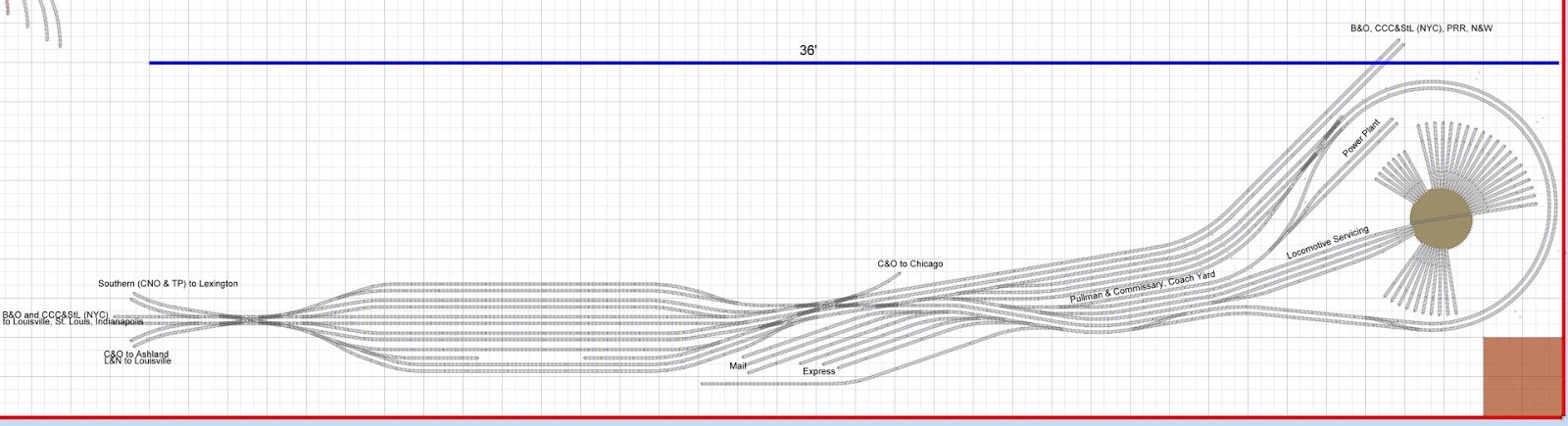
Here is a shot of my first attempt at a somewhat doable CUT track plan, at least for the terminal area. Well, it's not really doable because it is way too long at 36' length, especially since the connections to the rest of the layout on the left end are not even there yet. I'm about at the limit on length because the left end needs to be kept open (to a degree) for movement to and from the basement steps and the rest of the basement. The brown square in the lower right must be kept clear for access to my electric panel.
This plan has all the major elements I am looking for in the terminal. Minimum radius on passenger tracks of 40". I wanted to do #8 turnouts but they are too long, so these are all #6. Also, a #8 double slip switch has 4 throwbars instead of 2 for the #6. There are 5 platforms at the terminal with the longest platform track being 11' long. There are two sleeper stubs and also runaround tracks along the top and the bottom of the terminal. There is mail, express, commissary & Pullman, coach yard, and locomotive service. There is a certain level of challenge to the trackwork from an operational point of view, but it isn't beyond reach from the constructional point of view. A 130' turntable tops it all off. The loop around the roundhouse area actually existed at the real CUT for turning entire strings of passenger cars rather than doing them one at a time on the turntable.
I can envision stacking dogbone loops under the turntable loop and staging yards underneath the terminal tracks.
Next step is to maybe bend it somehow or figure out other ways to reduce the overall length. If I can bring the left end in about 10', it will give me room there to extend those connections to the rest of the layout.

Here is a shot of my first attempt at a somewhat doable CUT track plan, at least for the terminal area. Well, it's not really doable because it is way too long at 36' length, especially since the connections to the rest of the layout on the left end are not even there yet. I'm about at the limit on length because the left end needs to be kept open (to a degree) for movement to and from the basement steps and the rest of the basement. The brown square in the lower right must be kept clear for access to my electric panel.
This plan has all the major elements I am looking for in the terminal. Minimum radius on passenger tracks of 40". I wanted to do #8 turnouts but they are too long, so these are all #6. Also, a #8 double slip switch has 4 throwbars instead of 2 for the #6. There are 5 platforms at the terminal with the longest platform track being 11' long. There are two sleeper stubs and also runaround tracks along the top and the bottom of the terminal. There is mail, express, commissary & Pullman, coach yard, and locomotive service. There is a certain level of challenge to the trackwork from an operational point of view, but it isn't beyond reach from the constructional point of view. A 130' turntable tops it all off. The loop around the roundhouse area actually existed at the real CUT for turning entire strings of passenger cars rather than doing them one at a time on the turntable.
I can envision stacking dogbone loops under the turntable loop and staging yards underneath the terminal tracks.
Next step is to maybe bend it somehow or figure out other ways to reduce the overall length. If I can bring the left end in about 10', it will give me room there to extend those connections to the rest of the layout.
Wednesday, December 30, 2015
Not So Wordless Wednesday #3
 |
| Norfolk & Western Class J 602 preparing to leave with the Powhatan Arrow at Cincinnati Union Terminal |
I just can't resist commenting on this photo. The more research I do on Cincinnati Union Terminal, the more excited I become to model operations there. The N&W J Class locomotives were used on their named trains such as the Powhatan Arrow, Pocohontas, and The Cavalier, all of which were Norfolk to Cincinnati trains although The Cavalier switched its terminus from Cincinnati to Portsmouth OH by 1957. Interesting to note is the N&W was very late to dieselize its passenger fleet and ran all steam up to that same year.
Now all I need to do is get my hands on an HO scale version of one of these beauties.
EDIT: The original caption when I first posted this photo read that the Powhatan Arrow pictured above had just arrived at the terminal. This is incorrect because in 1952 the westbound train arrived at the terminal at 10:45pm and would have been facing the other direction upon arrival. N&W approached and egressed from CUT from the north end (railroad east) of the terminal. In the photo we are facing south-southwest and the sun is obviously fairly low in the eastern sky (to the left) which is evident from the lighting and shadows. Although we don't know what year this photo was taken, in 1952 the Powhatan Arrow left CUT for Portsmouth OH at 8:20am, so it is safe to assume this shot was taken in the morning sometime around when the train would have been leaving the station.
Wednesday, December 16, 2015

Monday, December 14, 2015
Scale track plan of Cincinnati Union Terminal
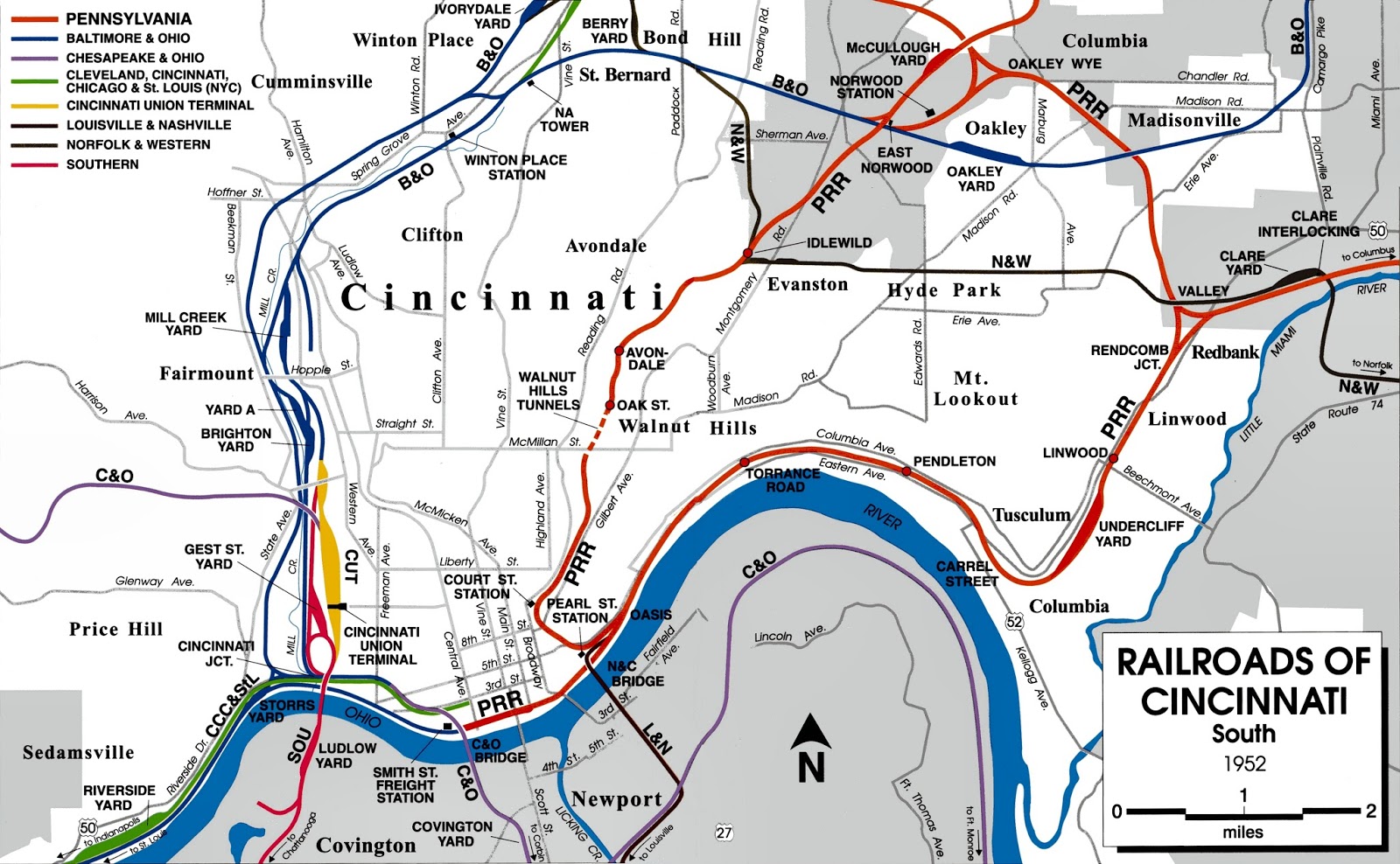
Just to see if it could be done and to say that I did it, I used AnyRail5 to make a loose scale track plan of Cincinnati Union Terminal, using this diagram:

Here is the end result. It actually fits in my train room. The entire train room (13' x 46'). The 8 platforms are about 1400' long instead of the 1600' that they really were. Other than that, it is pretty close although I did have to freelance in a few places to get the trackwork to align. I had to use #6 turnouts instead of #8's like I wanted to because the #8's made it about 10' longer, but then again this is just an experiment.

The bill of materials, track only:
44 x #6 Double Slip switches
45 x #6 Left turnouts
46 x #6 Right turnouts
24 x #6 Wye turnouts
Grand total of 841' of track.
Now that I have the Full Monte, I can begin the selective compression process. The remarkable thing is even in the full blown state it is in right now it is only just under 6' wide.
The terminal throats and ladder trackwork are very interesting and were designed with ease of operation in mind. The terminal was designed to allow switchers to buzz around both ends of the terminal to switch cars to and from passenger trains that may only be in the station for a few minutes, all without interrupting the traffic flow of the trains coming and going. Everything is double tracked at a minimum and in some places it is 3 or 4 parallel tracks and there are plenty of crossovers and double slips to allow the switchers to go around traffic.
Boiling the plan down to a workable size while still capturing the feel of it will be the challenge. This is the part where Cleveland Union Terminal gave me a headache.
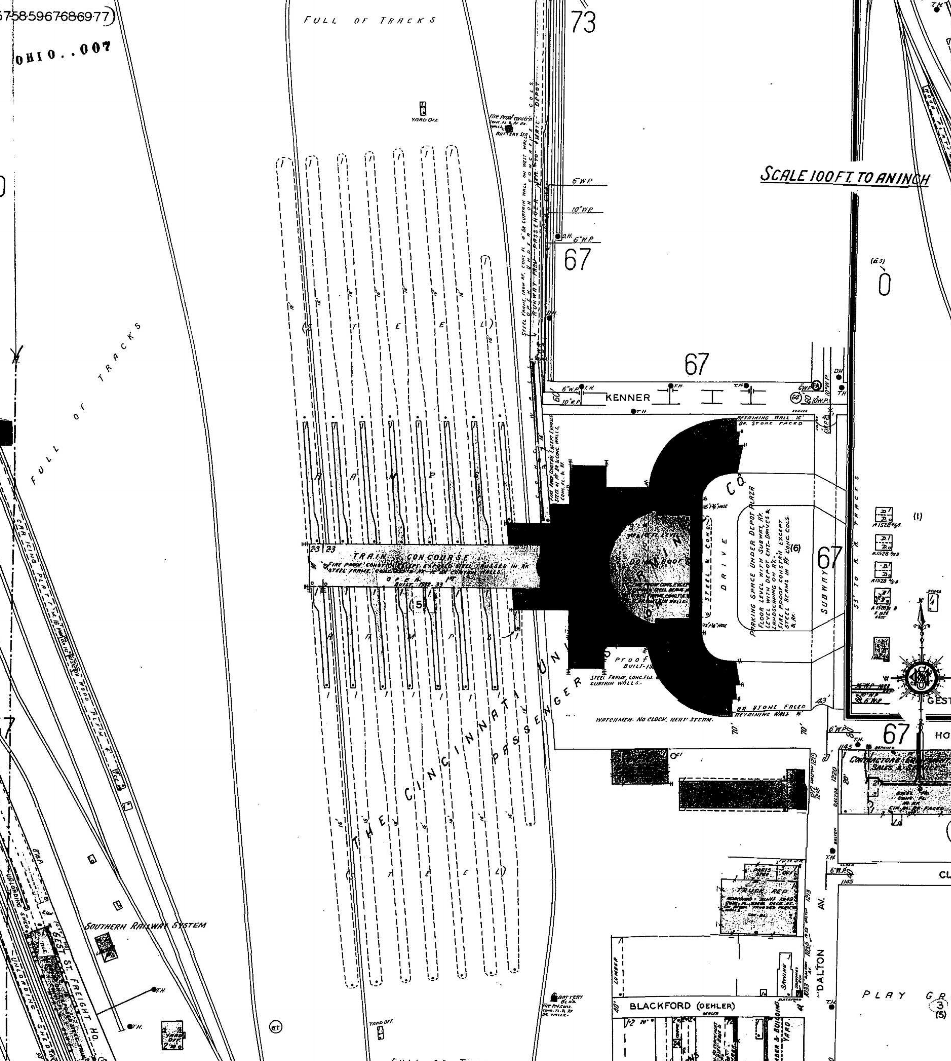
Here's a copy of a Sanborn map that shows how the platform widths conform to the transition from double track under the concourse to triple track towards the ends of the platforms.
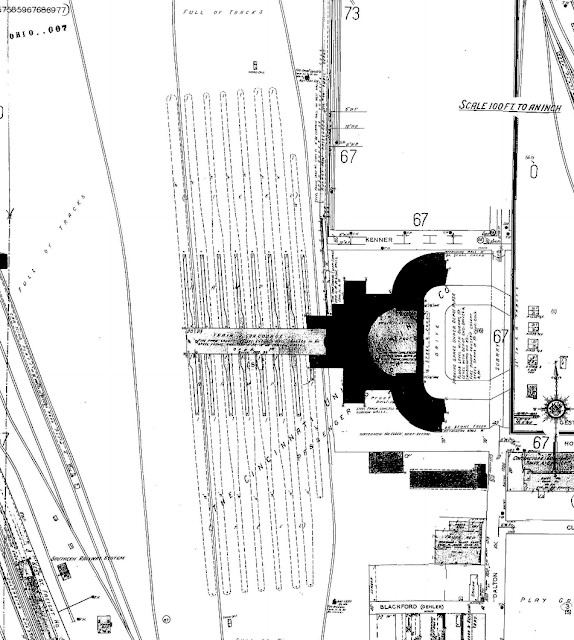

Here is the end result. It actually fits in my train room. The entire train room (13' x 46'). The 8 platforms are about 1400' long instead of the 1600' that they really were. Other than that, it is pretty close although I did have to freelance in a few places to get the trackwork to align. I had to use #6 turnouts instead of #8's like I wanted to because the #8's made it about 10' longer, but then again this is just an experiment.

The bill of materials, track only:
44 x #6 Double Slip switches
45 x #6 Left turnouts
46 x #6 Right turnouts
24 x #6 Wye turnouts
Grand total of 841' of track.
Now that I have the Full Monte, I can begin the selective compression process. The remarkable thing is even in the full blown state it is in right now it is only just under 6' wide.
The terminal throats and ladder trackwork are very interesting and were designed with ease of operation in mind. The terminal was designed to allow switchers to buzz around both ends of the terminal to switch cars to and from passenger trains that may only be in the station for a few minutes, all without interrupting the traffic flow of the trains coming and going. Everything is double tracked at a minimum and in some places it is 3 or 4 parallel tracks and there are plenty of crossovers and double slips to allow the switchers to go around traffic.
Boiling the plan down to a workable size while still capturing the feel of it will be the challenge. This is the part where Cleveland Union Terminal gave me a headache.
Here's a copy of a Sanborn map that shows how the platform widths conform to the transition from double track under the concourse to triple track towards the ends of the platforms.
Subscribe to:
Posts (Atom)